A Bag by Royal Demand: From Saddle Design to Style Monarchy
Before it graced magazine covers as fashion’s most sought-after handbag, the Hermès Kelly was known simply as “Sac à courroie”—a design born in the 1930s to carry equestrian saddles and accessories. But it wasn’t until 1956, when Princess Grace Kelly of Monaco famously shielded her baby bump with the bag in a Life Magazine photograph, that history—and the silhouette—took a sharply elegant turn.
Renamed the “Kelly” in her honor, the bag encapsulates what Hermès defines as "functional formality": each line deliberate, each proportion weightless yet precise—choreographed more than constructed.
Geometry in Leather: The Applied Art of Structure
The Kelly stands as a study in angles, volume, and balance. Unlike its sister, the Birkin, which favors opulent slouch, the Kelly is all poise and restraint.
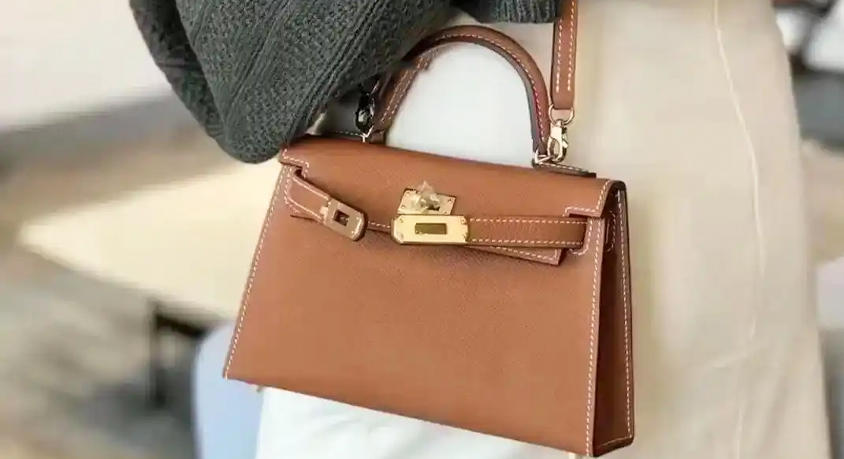
Its distinct trapezoidal silhouette starts with carefully measured gussets that taper at a 7.5° interior angle—a choice that optimizes volume without visual bulk. The rigid base features four brushed metal feet called "clous de fond" for wear protection and elevated symmetry.
Depending on size and model (Retourne for softer curves, Sellier for sharp edges), each Kelly is lined with matching chèvre or lambskin, enhancing tactile brilliance without distorting the architecture. The pivotable turn-lock "touret," lock, and key clochette hardware—made by Hermès’ in-house silversmiths in Pantin—are weight-tested to withstand over 20,000 rotations.
Leather Selection: Tension, Delicacy, and Discipline
Box calfskin remains the most iconic leather for the Kelly. Known for its mirror-sheen surface, tensioned grain, and smooth tactile refinery, it requires absolute environmental control during crafting—temperature, pressure, and humidity are all regulated to avoid cracking or discoloration.
“In a 28cm Box model, I use up to 16 tension clamps,” notes an anonymous Hermès artisan with 22 years of experience. “If the grain lifts during edging, even imperceptibly, the bag is rejected.”
Alternative leathers include Togo (grained and matte), Epsom (embossed for feather-light handling), or exotic variants like Shiny Porosus crocodile or Ostrich, where each follicle dot forms a biological mosaic.
Stitching Time into Form: The Hermès Saddle Seam
Each Kelly is hand-stitched using the famed "piqûre sellier" (saddle stitch). Two waxed linen threads, one needle in each hand, pass through a single awl-punctured hole at opposing angles. The technique locks each stitch independently—if one is cut, the entire seam remains intact.
The traditional stitch count varies between 5–7 stitches per cm depending on bag size and leather density, ensuring structural integrity while echoing time-honored Hermès craftsmanship, originally perfected in harness-making workshops.
From cutting and paring to assembly and finishing, a single artisan spends 18–25 hours per Kelly—a human fingerprint embedded in every edge ink, gusset curve, and handle seam.
Classic Versatility: Stylistic Balance from Desk to Dinner
What makes the Kelly defy trend cycles is its modular precision. The optional shoulder strap (especially in crossbody size 25 or 28cm) adds modern utility to old-world elegance. In Sellier construction, the cut edges and visible saddle stitching create a crisp silhouette ideal for formal tableaux. Retourne’s turned seams give a gentle curvature, better suited for casual elegance.
Styling Tips:
- Wear Kelly 25 Retourne with oversized blazers in cream, espresso, or dove grey for a Parisian-modern approach.
- Pair a Sellier 32 in Vert Cypress with matte gold hardware for autumn-to-winter neutrals.
- Let scarf-wrapped handles or twillys resonate with your personal color code—deep red for power, celadon blue for quiet clarity.
Care Ritual: Preserving Elegance One Gesture at a Time
Preservation is part of owning a Kelly. Wipe gently along grain using a sea sponge leather cloth; for Box leather, use Hermès glove-fabric microfiber cloth in circular strokes to retain its natural glaze. Always allow the bag to fully dry after any moisture exposure.
Insert cedar wood form shapers to maintain structure and absorb ambient humidity. Store upright in the original sleeper bag, nestled in its orange box, away from sunlight in a cool, dry cabinet. Locks and clochettes should be stored inside to avoid hardware pressure lines.
If edge ink wears or the shine dulls, Hermès offers specialist restoration through their "spas" in Paris and other maisons around the world, ensuring any touch-up honors the original artisan’s hand.
Heirloom Value: Investment Cast in Silence
The Kelly is not merely a luxury item—it’s a functional heirloom engineered for permanence. Because of the intensity of labor, material scarcity, and Hermès’ restricted output model (each year fewer Kellys are produced than demanded), the bag is routinely included in collector auctions at Christie's and Sotheby’s, often appreciating in value.
However, its return on investment isn’t just financial—it's temporal. Just as Princess Grace’s Kelly remains immortal decades after her reign, so too will yours, conditioned and worn gently, passed from one hand to another.
To own a Kelly is to carry legacy—stitched with restraint, detailed with mastery, and defined by the quiet gravity of disciplined design. It is as much a bag as it is a philosophy: that elegance is not a trend, but a skillful silence.